I am sharing a brief reflection following a grassroots gathering held to commemorate the Jeju April 3 Incident:
A Brief Explanation of April 3
April 3 refers to a popular uprising on Jeju Island, South Korea, aimed at preventing South Korea from establishing a separate government (South and North Korea were originally one country; the division of the nation under the partitioned rule of the U.S. and Soviet forces was an unacceptable situation), and the massacre of civilians by the South Korean government and the U.S. military government in response. Although U.S. troops did not fire the bullets themselves, the reason we hold them accountable is that the South Korean military was under U.S. command at the time (the U.S. held operational control in peacetime until 1994, and wartime operational control remains with the U.S. to this day; the U.S. still maintains military control over South Korea), and because the U.S. approved and supported the massacre operation.
Official Introduction to the April 3 Incident
The Jeju April 3 Incident began with a police shooting incident on March 1, 1947, and involved resistance against oppression by the police and the Northwest Youth Corps (a militia), as well as opposition to the single-party election and unilateral government, and continued until September 21, 1954, when the restricted area of Mount Halla was fully opened.
–from “Government Report on the Truth Investigation of the Jeju April 3 Incident”, p. 536
Triggered by the March 1, 1947, shooting incident (a symbolic day for the colonial liberation movement and recognised as an important day even after liberation) and the armed uprising on April 3, 1948, the April 3 Incident resulted in approximately 25,000 to 30,000 casualties during armed clashes between armed groups and the suppression forces as well as subsequent suppression operations. Approximately 40,000 homes were destroyed, and a significant number of villages in the mid-mountain regions were reduced to ruins. Public buildings such as schools and township offices were burned down, and various industrial facilities were destroyed.
With the conclusion of the April 3 Incident in 1954, reconstruction and resettlement efforts for the devastated villages began in earnest. However, the aftereffects left by the April 3 Incident on the Jeju community were not easily healed. The shackles of collective punishment and the National Security Act bound the bereaved families, and psychological wounds—such as lasting disabilities from torture and the “Red Complex”—remained unhealed. Those who fled to Japan due to the April 3 Incident were unable to return, and those who returned after served prison sentences or were subjected to surveillance by public security agencies.
– Excerpt from the introduction to the Jeju April 3 Peace Park
What should we call the Jeju April 3 Incident?
When I say “April 3 Massacre,” feelings of grief and anger, as well as apologies and accountability, come to mind. When I say “April 3 Uprising,” resistance, action, ideals, and failure come to mind. So, when I talk about it, I tend to use whichever term is more appropriate for the context—either “April 3 Massacre” or “April 3 Uprising.” I feel that calling it the “April 3 Uprising and Massacre” would be clearer, but the phrase becomes too long.
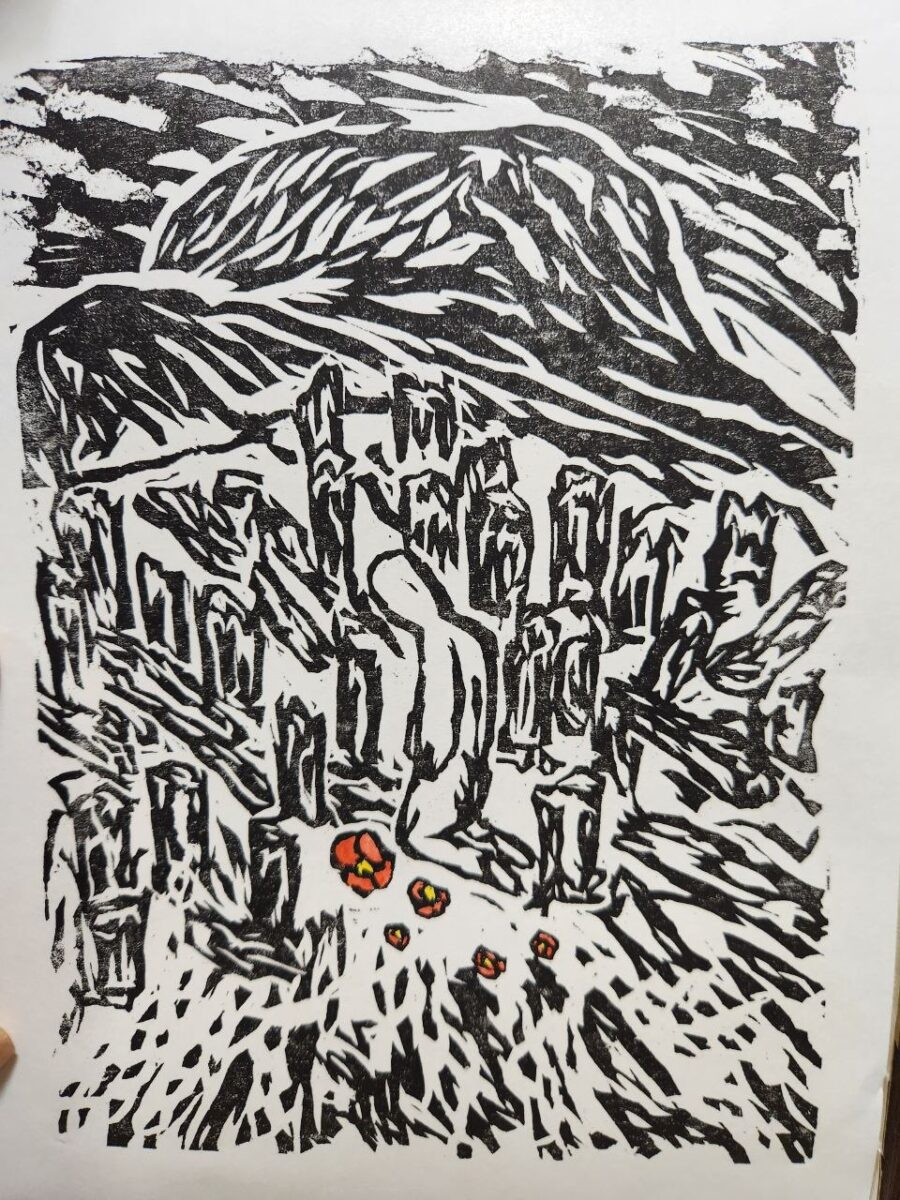
On April 3rd, the music group I’m part of held a memorial event called “Singing for April 3.” This was the third time we’ve held “Singing for April 3” since we started in 2024. It was proposed by a little-known music group, the venue wasn’t exactly convenient to get to, and since it was a modest gathering, I thought only one or two people besides us would show up. But more people came than we expected, just to participate in the singing. With a mix of awkwardness and joy, we spread out a white cloth, placed camellia flowers, set out rice cakes and castella, and lit candles. The attendees took turns reading writings about the April 3 Incident, sang “Song of the Baby Camellia” and “The Sleepless South,” and then shared food and their reflections. It was a small, quiet moment of remembrance.
Since the democratization government took office, the state has acknowledged its responsibility, issued an official apology, and officially recognized the April 3 Incident as a historical event.
As the anniversary of April 3 approached, related reports appeared on TV. For a long time, talking about April 3 was taboo; because all media remained silent for so long, new stories continue to emerge even now, 77 years later.
Why do we continue this small act of remembrance?
Is it because we’re angry at the government’s announcement to build a memorial hall honoring Syngman Rhee, the mastermind behind the massacre? Or is it because we cannot stand by and watch this contradiction—where the Liberal Party promises to take responsibility when in power, but right-wing governments turn a blind eye and ignore it? Is it because many on the right still openly insult and condemn the victims of April 3? Or is it because we need a space to tell our own stories, separate from state-led commemorations?
Everyone probably had their own reasons. One participant in the singing event spoke of their anger toward modern Korean history—and when I say “one participant,” I actually mean myself. People shared various stories: some said they’d never talked about the April 3 Incident before, others said they wanted to raise the flag, some mentioned that they still remembered participating in last year’s event, and others said they came to sing because it was only natural to pay their respects.
One person said they had no connection to Jeju Island but still wanted to talk about April 3rd. Where exactly is the line between those directly affected and those who aren’t? As I’m from Jeolla Province (where the May 18th Uprising occurred, a region that has faced discrimination), I’ve had a strange sense of victimhood and a feeling that I have to be careful, ever since I was a child. A strange feeling that we must remain quiet. Yet, if someone called Jeolla Province “communist,” I would instantly feel a surge of anger welling up inside me. We have been discriminated as a kind of McCarthyism. At times like that, I realize I still hold onto my identity as a person from Jeolla Province, but having lived almost my entire life in Seoul, I wonder if it makes sense to continue holding onto this feeling just because I lived there for a few years as a child.
When discussing the April 3 Incident, what people from Jeju feel is likely different from what those who aren’t from Jeju feel. After all, the crushing sense of pressure—something you can’t understand through books or media—can only be grasped through the sensation of personal experience. I believe that the act of remembering and commemorating is a process of recreating and internalizing similar experiences, but I don’t think that’s the most important thing.
I hope that the thick, acrid mass of memories so tightly bound to specific groups or minorities can be scattered widely and thinly across society as a whole, breaking the fragments of memory and pain into smaller pieces and distributing them evenly, so that they can be transformed into a collective sensibility and a shared public experience. Although the state now officially commemorates the event, that is no reason for us to hesitate to commemorate it in our own ways.
Let us remember and share our memories of April 3. Let us not stop the struggle to remember.